Light, and the time it takes
A camera is a passive instrument. It collects whatever light happens to already be in a room and records the colours that arrive.
A LiDAR sensor does the opposite. It emits its own light in short pulses, then times how long each pulse takes to return. Light travels at a known speed, so a measured time is a measured distance: halve the round trip and you know how far away the surface is. The technique is called time-of-flight, and the name LiDAR is short for light detection and ranging.
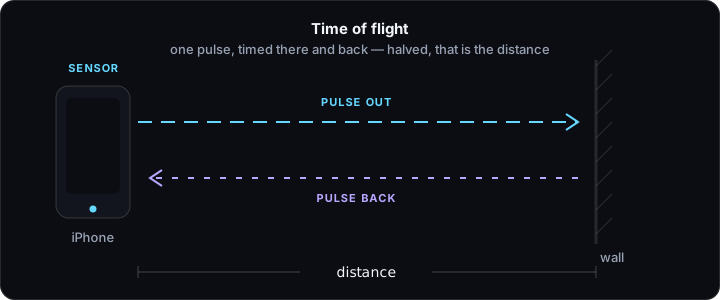
One pulse gives you one number — the distance to whatever is in one particular direction. Fire thousands of them across a room and you have thousands of distances. That collection is a point cloud: a scattering of measured positions where the building happens to be.
Apple put a LiDAR scanner into the iPhone in the 12 Pro, and it has been on the Pro models since. Its useful reach is a few metres, which is a room, not a street. That constraint is the whole reason it suits indoor work.
What it deliberately does not measure
This is the part people find surprising: a LiDAR sensor knows nothing about colour.
- A red wall and a blue wall at the same distance are identical to it
- It cannot read a door sign, a room number or a floor plan on the wall
- Patterned carpet and plain carpet are the same flat plane
That is not a shortcoming. It means the measurement is about shape alone, and shape is the thing that stays true. Paint gets redone. Posters come down. The wall does not move.
Why an unlit corridor is not a problem
Because the sensor supplies its own light, darkness makes very little difference to it. A room with the blinds down and the lights off scans much the same as a bright one. For anyone who has tried to photograph a dim stairwell, this is a meaningful difference in kind, not degree.
Where it genuinely struggles
Worth being straight about the limits.
Time-of-flight depends on light coming back the way it went out. Surfaces that refuse to cooperate cause trouble:
- Glass lets the pulse straight through, so a window can read as a hole
- Mirrors return a reflection of somewhere else entirely
- Very dark, matte surfaces absorb enough light that little comes back
- Highly polished floors can scatter the return away from the sensor
Every depth sensor has some version of this problem. Knowing about it is what lets software compensate for it.
How ICIDO uses the two together
ICIDO reads geometry from the LiDAR sensor and uses the camera for something different: recognising which place you are standing in. The sensor supplies the shape of a room; the camera supplies the visual detail that distinguishes your kitchen from a room of identical dimensions elsewhere.
The shape is what gets kept. The rest is a means to an end.